Understanding Utility Rates

We know your utility bill can be a bit confusing, so we’ve put together this FAQ to answer some questions you may have.

What’s included in your City utility bill?

Your City of Red Deer utility bill includes fees for water, wastewater, and waste collection services. 

Red Deer’s cart program includes every other week on alternating weeks pick-up of Blue (recycling) and Black Carts (garbage) and weekly pick-up of Green Carts (organics) from early-April to mid-November and every other week on the same week as Blue Carts from mid-November to early-April. For further information visit our Garbage, Recycling & Organics section.

With the implementation of EPR legislation on April 1, 2025, residential and multi-family customers will no longer be billed for recycling collection. More information on EPR can be found at https://www.alberta.ca/regulated-extended-producer-responsibility-programs.
How does The City determine utility rates?

City Council approved the 2026 budget for Utilities in Fall 2025. The budget determines the amount of revenue The City must recover through utility rates. From there, The City forecasts the number of customers to be served, the amount of commodity to be used, and the demand placed on the system from small and large customers. The goal is to maintain safe, reliable, affordable, and environmentally responsible services, while protecting future.

There are two components to utility rates – a fixed monthly charge and a usage charge. The fixed charge recognizes that much of the cost of operating and maintaining the utility infrastructure isn’t dependent on how much of the commodity is used. The fixed charge considers the potential demand that a customer places on the system; so large customers typically pay a higher fixed charge than small customers do.

The usage charge recognizes that some costs are related to consumption and encourages consumers to use less. Even though only a small portion of utility operating costs are related to usage in any particular year, overall reduction in use will reduce system demand and allow future capacity increases to be deferred. In the long term, this reduces the cost to operate the utility.

Why is Wastewater based on 90% of water usage, even in the summer months?

The City has estimated that the amount of wastewater throughout the year produced by each customer is approximately 90% of their water usage. Over the course of a typical year, the total volume of wastewater treated from city customers is approximately the same as the volume of water distributed to city customers. Even though some water is used for irrigation during the summer months and doesn’t directly enter the wastewater system, some groundwater and surface water does enter the wastewater system, particularly during and following heavy rains, which has to be treated at the Wastewater Treatment facility; which is why The City has estimated the Wastewater consumption charge.

How are utility charges used?

Revenue generated by utility rates is used to cover the cost of providing a number of services for City and regional customers, including:

  • Treatment and distribution of safe, reliable water for households, businesses, and fire protection;
  • Collection and treatment of wastewater from households and businesses to protect the health of our citizens, the river habitat, and downstream users; and,
  • Collection and disposal of solid wastes in an environmentally responsible manner, with emphasis on recycling and reuse.
Why are utility rates changing?

Utility rates are re-evaluated each year and rates are adjusted to generate sufficient revenue to meet budget needs. Budget changes are affected by inflation, growth, and the services provided. 

Is there a way I can have more control over my utility bill?

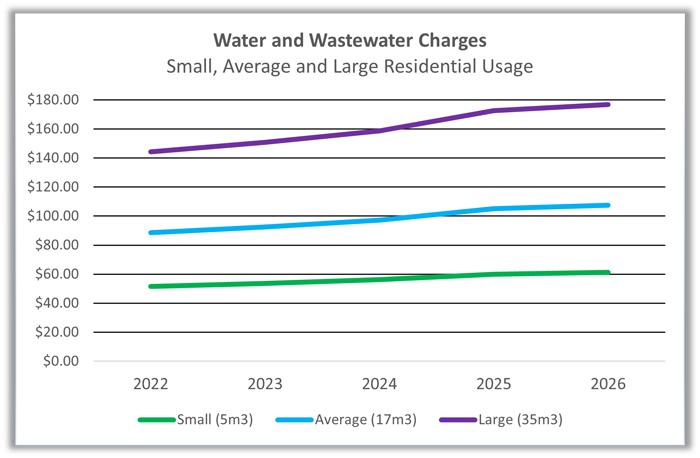
Yes, you can control the usage portion of your utility bill by conserving water. Based on the 2026 rates, household that uses 17 m3 will see an increase of 5% for water, 0% for wastewater, and 5% for cart collection.

Water and Wastewater Charges - 2026

Try these tips for conserving water:

  • Upgrade older toilets with water efficient models
  • Collect rain water to water your garden
  • When doing laundry, match the water level to the size of the load
  • When washing dishes by hand, don’t let the water run while rinsing. Fill one sink with wash water and the other with rinse water

For more water conservation tips, please visit reddeer.ca/water

What are this year's utility rates?

Rate changes for 2026 were approved by City Council. For residential customers, the average household (based on 17 m3 usage and a Medium Black cart) will see an increase of approximately $3.36.

RESIDENTIAL 2026 2025
Water – Fixed Monthly Fee (16mm meter)  $19.58  $18.70
Water – Usage rate per m3  $2.04  $1.95
Waste Water – Fixed Monthly Fee  $22.45  $22.45
Waste Water – Usage rate per m3*  $2.01  $2.01
Small Black Cart**  $17.00  $16.30
Medium Black Cart**  $22.00  $21.05
Large Black Cart**  $29.75  $28.30
Average Bill for 17m3* & Medium Cart**  $129.46  $126.10
 
NON-RESIDENTAL
Changes vary by meter size and services provided.  Please see the Utility Bylaw for details.

* Wastewater is based on 90% of water usage

**Cart charges are based on your Black Cart size.  See our Garbage, Recycling & Organics page for full details on what is included in your Cart services.

If you have specific questions about your utility bill, please see our Billing Concerns web page for more details.